What Triggers a Snow Day? The 5 Factors Explained
For millions of students, the question What triggers a snow day? It is a winter ritual. The hope for a day off from school builds with every falling snowflake. However, for the school officials making the call in the early morning hours, the answer isn’t a guess; it’s a complex safety calculation.
While the final decision rests with them, you don’t have to wait for the official robocall to know what’s coming. By understanding the key factors that influence their choice, you can make a surprisingly accurate prediction. To get the most precise forecast, our Snow Day Calculator analyses all these triggers in real-time for your specific location. Let’s explore what goes into that all-important decision.
The 5 Scientific Triggers of a Snow Day
The decision to cancel school is a science of risk management. Superintendents weigh several critical weather and logistical factors to ensure student safety. Here are the five main triggers they evaluate.
1. The Snowfall Threshold: It’s Not Just About Inches
Every region has a different trigger point for closing schools based on snow accumulation. A couple of inches might shut down a city with limited ploughing infrastructure, while a town accustomed to heavy winter weather can handle much more. The rate of snowfall also matters; three inches falling in one hour during the morning commute is more disruptive than six inches spread over a full day.
Here’s a general idea of how thresholds can vary by region:
| Region | Typical Snow Day Trigger | Reason |
| Atlanta, GA | 1-2 inches | Limited plough infrastructure and experience. |
| Buffalo, NY | 6+ inches | Well-equipped for heavy snow. |
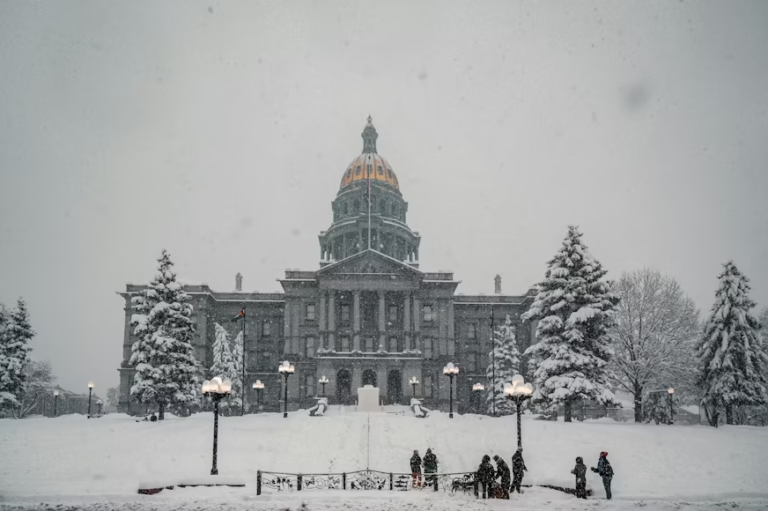
| Denver, CO | 8+ inches | Mountain terrain and community preparedness. |
Our Snow Day Calculator automatically adjusts for your region’s specific snowfall threshold, so you get a prediction tailored to your local context.
2. The Invisible Danger: Ice and Freezing Rain
Superintendents often fear ice more than snow. Freezing rain and black ice create exceptionally hazardous road conditions that are difficult for even experienced drivers to navigate. School buses, with their high centre of gravity, are particularly vulnerable on icy roads.
A mere quarter-inch (0.25 inches) of ice accumulation can make roads impassable and is far more dangerous for school buses than six inches of powder snow. Because of this heightened risk, even a small amount of forecasted ice can be enough to cancel school. The calculator heavily weighs ice storm warnings from the National Weather Service in its algorithm.
3. The Deep Freeze: How Wind Chill Cancels School
Sometimes, school is cancelled without a single snowflake in sight. Extreme cold, measured by the wind chill factor, poses a significant health risk to students waiting at bus stops. When the wind chill plunges to dangerous levels, the risk of frostbite and hypothermia becomes a primary concern. Most districts will consider a Cold Day when the wind chill is forecasted to be between -20°F and -25°F. At these temperatures, frostbite can occur on exposed skin in under 30 minutes. We integrate real-time wind chill data, so you’ll know if extreme cold alone might be the trigger.
4. Logistics & Visibility: The On-The-Ground Reality
A superintendent’s decision isn’t final until they get reports from the ground. At around 4 AM, transportation crews drive the most challenging bus routes, particularly rural back roads, to assess their condition. They check if ploughs are keeping up with the snowfall and if visibility is safe for driving.
If ploughs can’t clear roads fast enough or if whiteout conditions exist, it becomes too dangerous to run the bus routes. While we can’t drive the roads for you, our tool factors in live road condition reports and visibility forecasts from trusted sources to simulate this part of the decision.
5. The Timing Factor: Why a 5 AM Storm is Key
When the snow falls is just as important as how much falls. A storm that dumps six inches of snow but ends by midnight gives road crews plenty of time to clear the streets before the morning commute. However, a storm that drops just three inches starting at 5 AM can cause chaos.
This is why the delayed start is a common compromise. It gives road crews a few extra hours to make routes safe. The calculator analyses the forecasted peak intensity of the storm and compares it directly to your school’s start time to evaluate this crucial timing factor.
Behind the Scenes: The 4 AM Decision Room
Contrary to popular belief, calling a snow day isn’t a matter of guesswork. It’s a methodical, pre-dawn risk assessment with student safety as the non-negotiable priority.
The process typically starts before 4 AM. The superintendent and transportation director review the latest forecasts from the National Weather Service. At the same time, transportation crews are out driving key routes, reporting back on real-world conditions. After gathering all this information, key officials hold a conference call to make the final decision based on the five triggers detailed above. This structured process ensures the choice is based on data, not just a glance out the window.
The superintendent’s 4 AM checklist includes:
- Latest Briefings: Overnight updates from the National Weather Service.
- Ground Truth: Live reports from transportation crews driving bus routes.
- Logistical Intel: Conversations with city plough operators and local police.
- The Final Call: A conference call with key officials to weigh all factors.
Beyond Guessing: How to Accurately Predict Your Snow Day
While you now know what triggers a snow day, piecing all this data together yourself at 5 AM while checking multiple weather apps and news sites is nearly impossible.
This is why we built the Snow Day Calculator. It does the heavy lifting for you, consolidating all the critical information into one simple, reliable prediction.
Here’s how it works:
- Input: You provide your zip code.
- Analysis: Our system instantly cross-references live data for all five triggers: regional snow accumulation, ice forecasts, wind chill, road conditions, and storm timing.
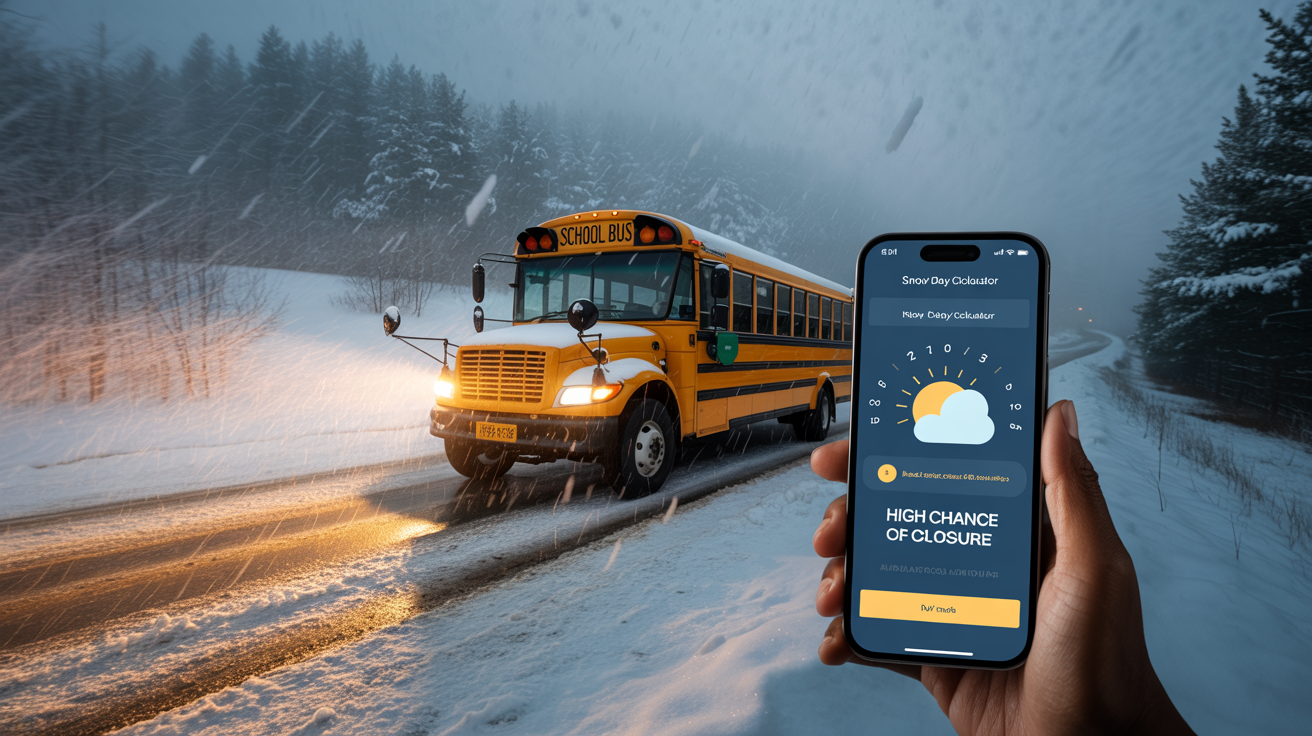
- Output: You get a clear, percentage-based probability of a snow day, with a straightforward prediction like High Chance or Unlikely.
Stop refreshing the weather app and hoping. Check Your Snow Day Odds Now with our free Snow Day Calculator!
Be Prepared, Not Surprised
Understanding the five key triggers snowfall, ice, wind chill, road conditions, and timing—turns the mysterious snow day into a predictable event. By examining the same data that school officials use, you can get a head start on planning your day.
Bookmark our calculator, have the hot chocolate ready, and wake up to certainty, not a surprise. We’ll help you get the news first.