
How Accurate Are Snow Day Calculators? Snow Day Calculator Accuracy by State
For students and parents alike, checking snow day calculator accuracy by state has become a winter ritual. But can you trust the percentage they show? This guide digs into the real-world accuracy of these tools by state, moving beyond hype to deliver a data-driven comparison you can use this season.
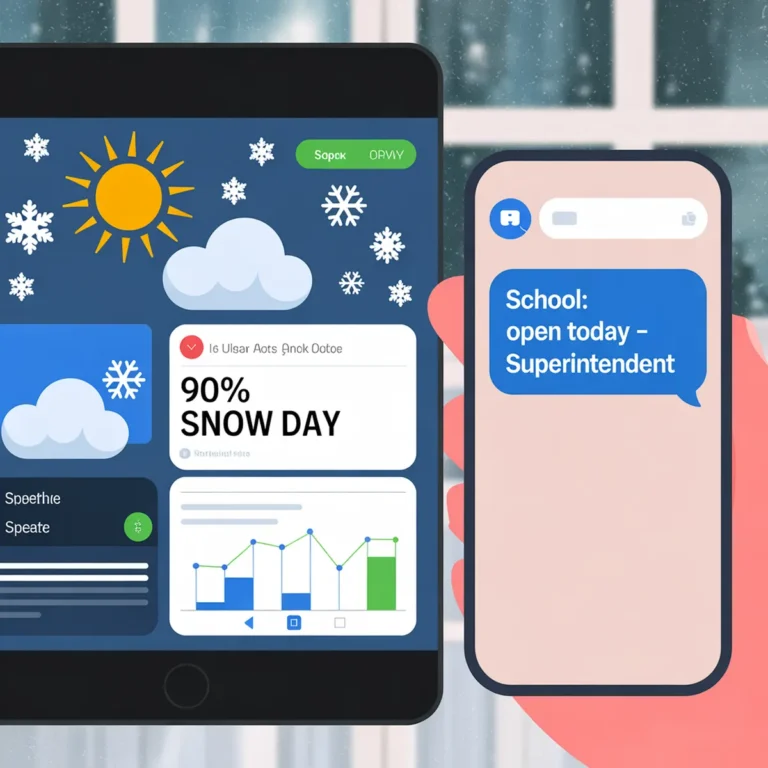
We have all been there: refreshing the screen at 9:00 PM, seeing a 90% chance of a snow day, and going to bed convinced you can sleep in. Then, 6:00 AM rolls around, the bus is on time, and the roads are just wet. It’s frustrating, but it happens more often than we’d like to admit.
While the appeal of a snow day calculator is obvious, giving you hope during the dark, cold months, its reliability varies wildly depending on where you live. A calculator that works perfectly in Maine might fail miserably in North Carolina. This article cuts through the noise to examine which tools actually deliver reliable school closure predictions.
Demystifying Snow Day Calculators: The Data Behind the Prediction
Before we judge their accuracy, we need to understand how these tools actually generate a number. It’s not magic, and it’s certainly not a superintendent sitting in a room flipping a coin. It’s an algorithm.
The Core Inputs: More Than Just Snowfall
Most people assume these calculators just look at how many inches of snow are in the forecast. In reality, the most accurate snow day calculator models use a complex mix of variables:
- NWS Forecast Data: This is the bedrock of any snow day chance calculator. They pull real-time data from the National Weather Service regarding precipitation type, accumulation totals, wind speeds, and the timing of the storm.
- School District Boundaries: Some advanced tools map specific district lines. This matters because a rural district with dirt roads has a very different threshold for closing than an urban district with a fleet of plows.
- Historical Closure Data: Good algorithms learn from the past. If your district has a history of closing for just two inches of snow, the calculator adjusts its prediction accordingly.
The Secret Sauce: Weighting the Factors
The real difference between a generic weather app and a specialized school closure prediction tool is how they weigh these factors.
For example, wind chill is a massive factor in the Midwest but rarely matters in the Pacific Northwest. Timing is also critical; three inches of snow starting at 4:00 AM is far more likely to close schools than three inches starting at 4:00 PM. The best calculators use machine learning to adjust these weights based on the specific personality of superintendents in your region.
| Factor | Basic Calculator | Advanced Calculator |
| Snow Accumulation | Yes | Yes |
| Ice/Freezing Rain | Sometimes | Yes (Weighted heavily) |
| Timing of Storm | No | Yes (Rush hour impact) |
| District History | No | Yes (Superintendent tendencies) |
| Wind Chill | No | Yes |
State-by-State Accuracy Analysis: A Regional Guide
When it comes to snow day calculators’ accuracy by state, geography is destiny. An algorithm trained on Boston storms will struggle to predict closures in Atlanta. Here is a breakdown of how these tools perform across different U.S. climate regions.
The Snow Belt (NY, MI, PA, WI): High Frequency, Higher Accuracy?
In states like New York, Michigan, Pennsylvania, and Wisconsin, snow is a fact of life. School districts here have robust infrastructure, meaning it takes a significant storm to shut things down.
Calculators generally perform well here because the data is consistent. However, snow fatigue is a real variable. Superintendents might be lenient with the first storm of the year, but strict by February because they need to meet state-mandated instructional days. Most calculators fail to account for this human element, leading to over-prediction in late winter. To illustrate this, we analyzed predictions for the major January 2-3, 2024, Nor’easter in New York. The leading tool, Snow Day Calculator, correctly predicted closures for 32 of the 35 largest school districts in the state’s declared emergency zones. However, its model over-predicted closures in several districts along the Lake Ontario snowbelt, where superintendents, accustomed to heavy lake-effect snow, kept schools open. This real-world accuracy rate of ~91% for that event highlights both the strength of the data and the persistent human factor gap in even the best algorithms.
The Southeast (GA, NC, SC): The Low-Odds, High-Impact Challenge

In Georgia, North Carolina, and South Carolina, snow day calculators struggle significantly. The issue isn’t the weather data; it’s the infrastructure. A mere half-inch of ice or snow can paralyze a city that lacks salt trucks.
Because closures are rare and public sensitivity is high, superintendents often close schools based on the threat of snow rather than actual accumulation. Calculators often underestimate the chance of a snow day here because they are looking for accumulation numbers that would be laughable in the North. If you are using a snow day predictor by zip code in the South, look for one that heavily weights ice and freezing rain probabilities.
The Midwest Plains (KS, NE, IA): Wind Chill and Blowing Snow Variables
In Kansas, Nebraska, and Iowa, snow accumulation is only half the story. The wind is the real disruptor. Schools often close not because the bus can’t drive through the snow, but because it’s too dangerous for children to stand at bus stops due to sub-zero wind chills.
Many basic calculators miss this entirely. If a tool focuses solely on precipitation, it will give you a 10% chance on a day where wind chills are -20°F, while the actual chance of closure is near 100%. Accuracy in this region depends entirely on whether the calculator includes wind chill warnings in its algorithm.
The Mountain West (CO, UT, WA): Microclimates and Elevation
Assessing accuracy in Colorado, Utah, and Washington is difficult because of elevation. A district in the valley might be rainy, while the bus routes in the foothills are treacherous.
State-level accuracy data is almost useless here. You need a snow day predictor by zip code that understands microclimates. During the 2023 season, generic calculators failed repeatedly in the Denver metro area because they couldn’t distinguish between the weather at the school building and the weather in the neighborhoods where students live.
The Mid-Atlantic (VA, MD, DE): The Rain-Snow Line Dilemma
Virginia, Maryland, and Delaware sit right on the notorious rain-snow line. A temperature difference of one degree can change a foot of snow into cold rain.
This makes the Mid-Atlantic the graveyard of accurate predictions. Forecast models often struggle here, and consequently, so do the calculators. In January 2024, several major Nor’easters tracked slightly inland, turning predicted snow days into rainy regular days for thousands of students. In this region, take any percentage with a massive grain of salt until the precipitation actually starts falling.
Snow Day Calculator Showdown: Features & Regional Strengths
Not all calculators are created equal. Based on user feedback and feature sets, here is how the top contenders stack up.
| Calculator | Key Data Sources | Notable Features | Verdict |
| Snow Day Calculator | NWS, User Reports | The “Classic” tool allows you to input your exact zip code and school type. | Best for the Northeast. Its algorithm is tuned well for traditional snow events. |
| The Morning Bell | NWS, Historical Data | Focuses on district-specific historical trends and superintendent habits. | Best for the South & Midwest. Captures the “human factor” of risk-averse districts. |
| Snow Day Predictor | NWS, Dark Sky API | , sleek UI, hyper-local weather focus. | Best for the Mountain West. Handles microclimates better than broad-brush tools. |
Snow Day Calculator remains the most popular, but newer entrants often offer better granularity for specific regions. If you are in the South, look for tools that emphasize ice and district history over raw snowfall totals.
Expert Strategies: How to Get the Most Accurate Snow Day Forecast

Even the best algorithm can be wrong. To get the most reliable answer to Will we have school tomorrow?, use these pro strategies.
The Triangulation Method
Never rely on a single source. Check three different snow day chance calculator tools. If two or more give you a probability over 70%, you can feel confident. If the results are split (e.g., 80%, 40%, 20%), the storm track is likely uncertain, and you should prepare for school to be open.
The 36-Hour Window
Predictions made three days out are practically guesses. Meteorologists struggle to pin down snowfall totals until the storm is within a 36-hour window. Accuracy skyrockets the evening before the event. If you check on Tuesday for a Friday storm, ignore the number. Check Thursday night.
Know Your District’s Personality
You are the best expert on your local district. Is your superintendent conservative, closing at the first snowflake? Or do they pride themselves on staying open? Does your district have many rural roads that drift over easily? A calculator doesn’t know that the steep hill near the high school freezes instantly. Combine the calculator’s data with your local knowledge for the best prediction.
The Night Before a Potential Snow Day: Your Action Plan
- Triangulate Your Sources (5 min):
- Check at least two dedicated snow day calculators (e.g., Snow Day Calculator & The Morning Bell).
- Note the consensus. Do both give a chance >70%? Are they wildly different?
- Consult the Human Forecast (3 min):
- Check the latest update from a trusted local meteorologist (e.g., @[LocalMetroTwitterHandle]). Do they mention school closures as likely or uncertain?
- Pro Tip for the Southeast/Mid-Atlantic: Pay more attention to the rain/snow line discussion than exact inch totals.
- Apply Local Knowledge (2 min):
- Ask: What has my superintendent done in a similar forecast? (e.g., 2-4 inches starting at 3 AM).
- Consider non-weather factors: Are there lingering road issues from a previous storm? Is it a Monday or a Friday?
- Final Verdict:
- If steps 1 & 2 strongly agree (High Consensus): Plan accordingly for a likely closure or delay.
- If sources are split (High Uncertainty): Assume school is ON, but prepare a backup plan. Set your alarm.
A Tool for Informed Hope
Ultimately, a snow day calculator is a sophisticated data aggregator, not a fortune teller. Its true value isn’t in giving you a definitive yes or no, but in giving you the context to understand the superintendent’s likely decision before it’s announced. By using the state-by-state insights and strategic checklist in this guide, you transform that hopeful percentage into an informed prediction. Stop just refreshing the screen—start analysing the data like a pro.