History of Snow Day Closures in the U.S. and Canada: Is This Childhood Ritual Fading?
For generations, the magical snow day was a universal childhood right in North America, a sudden gift of freedom announced by crackling radio static or a frantic scroll of text at the bottom of a television screen. But this cherished tradition, born from the era of horse-drawn sleighs and centralized school buses, is now facing its greatest threat: the irrelevance of distance itself.
As technology bridges the gap between the classroom and the living room, the history of snow day closures in the U.S. and Canada reveals a shifting landscape. It is a story that moves from individual grit to institutional liability, and finally, to a digital debate about whether a pause in our routine is a loss of productivity or a vital mental health necessity.
My Grandfather’s Walk
To understand the current debate, we have to look back at where we started. My grandfather, living in rural Ontario in the 1940s, didn’t have snow days in the modern sense. He had impassable drift days. There was no central authority to tell him to stay home. His decision to trek two miles to the one-room schoolhouse was his alone, or rather, his parents’. It was a calculation of grit versus danger that his grandchildren would never know.
If the wood stove at the schoolhouse was lit, school was in session. If you couldn’t make it, you missed the lesson. The responsibility of attendance lay entirely with the family. This rugged individualism defined the early history of education in North America, but it couldn’t last as populations grew and schools consolidated.
The Great Consolidation: How Buses Invented the District-Wide Closure
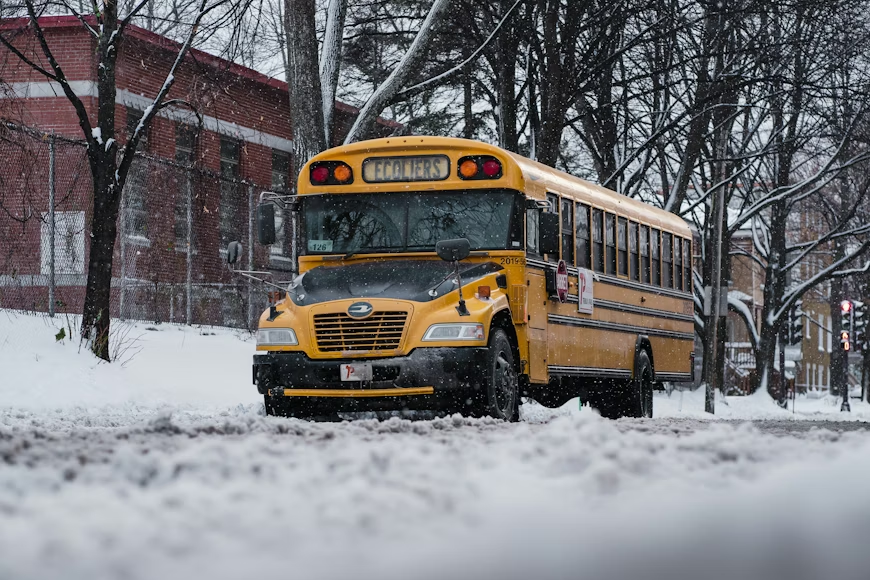
The modern concept of the snow day was truly invented by the yellow school bus. As one-room schoolhouses faded away in the mid-20th century, they were replaced by large, centralized district schools. Suddenly, education was no longer local; it was regional.
This shift transferred the power of the decision from the parent to the superintendent. As one retired New York state transportation director noted, the bus changed everything. A single icy hill could strand 500 kids. We didn’t just manage education; we managed risk.
This centralization happened rapidly in the densely populated U.S. Northeast and Midwest. Strict protocols were developed to manage liability. In Canada, particularly in the prairies and remote northern regions, localized decision-making held on longer. However, by the 1970s, the district-wide cancellation had become the norm across the continent. If the buses couldn’t run safely, the doors didn’t open.
The Dawn Patrol: A 4 AM Ritual
For students, a snow day is magic. For a school superintendent, it is a logistical nightmare. The decision-making process is a high-stakes gamble that begins long before the sun rises.
The Dawn Patrol typically starts around 4:00 AM. It involves a coordinated effort between meteorologists, road crews, and transportation officials. While every district is different, the superintendent’s 4 AM checklist usually looks like this:
The Decision Engine
- Road Condition Assessment: Transportation supervisors drive the most treacherous backroads in the district to test braking distances.
- Temperature Check: In Canada and the northern U.S., diesel fuel begins to gel at extremely low temperatures, meaning buses might not start even if the roads are clear.
- Timing the Storm: If snow is predicted to start at 2:00 PM, the risk isn’t getting students to school, but getting them home.
- The Domino Effect: Superintendents often confer with neighboring districts. If one closes, pressure mounts for others to follow suit to maintain uniformity for working parents.
There is a distinct difference in how this plays out across the border. In the U.S., the decision is often hyper-localized to the specific school district superintendent. In parts of Canada, such as Nova Scotia, Regional Centres for Education make consolidated calls that affect entire counties, removing the burden from individual towns.
The Announcement Evolution
The method of delivering the news has evolved alongside the closures themselves, creating specific generational memories.
In the 1960s and 70s, families gathered around the radio, listening through the static for their town’s name. By the 1980s and 90s, the ritual shifted to television. Do you remember the tense silence of waiting for your district’s name to appear on the scrolling ticker at the bottom of the news broadcast? If you missed the Bus, you had to wait for the entire alphabet to cycle through again.
Today, that communal anxiety is gone. It has been replaced by the sterile efficiency of an automated text message or a push notification at 5:30 AM. While efficient, this shift stripped the event of its shared cultural experience. The collective cheer of a neighborhood has been replaced by isolated screentime.
The 21st Century Fracture
The biggest shift in the history of snow day closures in the U.S. and Canada arrived with the widespread adoption of high-speed internet and personal devices. The COVID-19 pandemic accelerated a trend that was already bubbling: the E-Learning Day.
The logic is sound from an administrative perspective. In many U.S. states, schools are legally required to provide a specific number of instructional days. Traditional snow days often meant extending the school year deep into June. By pivoting to remote learning, districts can keep their summer break intact.
In 2023, distinct fractures appeared in how districts handled this. Some districts in Minnesota formally replaced snow days with Flex Learning Days, requiring students to log in for assignments. Conversely, districts in Vermont have passed resolutions protecting traditional snow days, citing them as crucial for community well-being and the mental health of children.
The Canadian approach has been slightly different. In provinces like Ontario and British Columbia, the school year-end date is often fixed regardless of cancellations. There is less administrative pressure to make up the days, leading to a stronger resistance against mandatory virtual learning during blizzards. In Quebec, the cultural value of the snow day remains high, with many boards rejecting the idea of pivoting to online classes for short-term weather events.
Case Studies in Snow: A Tale of Two Blizzards
To understand the cultural weight of these decisions, we can look at two historic weather events that highlight the difference between a system failure and a community triumph.
Boston, 2015
During the record-breaking winter of 2015, Boston was buried under feet of snow. The pressure to keep schools open led to controversial delays in closure announcements. When schools finally closed, the transit system failed, and the city ground to a halt. The political fallout was immense, highlighting the friction between economic pressure to keep the city moving and the reality of public safety.
St. John’s, Newfoundland, 2020
Contrast this with Snowmageddon in St. John’s. When a blizzard dumped nearly 30 inches of snow on the city, a state of emergency was declared. Schools weren’t just closed; the city was shut down for a week. The narrative wasn’t about lost learning time. It was about neighbors digging out neighbors. The closure became a source of civic pride and resilience, proving that sometimes, a complete stop is necessary for survival.
The Future: Climate, Remote Work, and the Fading Magic
As we look forward, two factors will dictate the future of the snow day.
The first is climate change. Data from NOAA and Environment Canada indicate a trend of declining annual snow days in the lower Great Lakes region over the past 50 years, while extreme weather events are becoming increasingly severe. The routine snow day may become a rarity, replaced by infrequent but catastrophic weather events.
The second is the culture of remote work. As parents increasingly work from home, the economic disruption of a school closure is minimized. However, this also removes the barrier protecting the snow day. If parents are working online, why shouldn’t the children?
My grandfather’s walk was a battle with nature. My childhood snow day was a gift from the superintendent. For the next generation, a snow day might just be a different login prompt. The history of snow day closures is, ultimately, a history of how technology continues to mediate our relationship with the natural world—and what we lose each time that interface becomes more efficient.
Should We Save the Snow Day?
As districts rush to adopt e-learning policies, we have to ask what is being lost. Is the joy of an unexpected break worth the logistical headache? Do you believe the traditional snow day should be preserved as a cultural institution, or has technology made it an obsolete tradition?
FAQs: The History of Snow Day Closures in the U.S. and Canada
What is considered the first major “snow day” event in North American history?
While snow has always disrupted life, the Great Blizzard of 1888 (also called the “Great White Hurricane”) is often cited as a foundational event. It paralyzed the U.S. Northeast with up to 50 inches of snow, shutting down cities, railroads, and schools for days. It created a modern awareness of how severe weather could bring organized society to a complete standstill.
How did schools and workplaces decide on closures before modern forecasting?
Decisions were purely local and reactive. School principals or town officials would make a judgment call at dawn based on visible conditions. There was no warning system, so closures were often announced by notifying local radio stations, through community phone trees, or even by having a custodian hoist a specific flag at the school.
What was the role of radio and TV in the history of snow days?
The rise of radio in the 1920s-40s and television in the 1950s-70s revolutionized snow days. They created the iconic ritual of children gathering around a radio or TV in the early morning to listen for scrolling school closure lists or watch the “crawl” at the bottom of the screen. This turned the snow day into a shared, anticipatory community experience.
How have “snow days” historically differed between Canada and the northern U.S.?
Communities with more predictable and frequent snow (e.g., much of Canada, Minnesota, Upstate New York) developed greater infrastructure (snow plows, indoor locker rooms) and cultural resilience, leading to fewer closures per inch of snow. Regions less accustomed to major snowfalls (e.g., the U.S. South, Pacific Northwest) have historically closed more readily due to a lack of equipment and driver experience.
What is the biggest threat to the traditional snow day in the 21st century?
The advent of widespread, reliable technology for remote learning. Following the experience of the COVID-19 pandemic, many school districts in both the U.S. and Canada have adopted formal “virtual learning day” policies to replace cancellations. This allows education to continue uninterrupted during bad weather, effectively ending the classic, surprise “free day off.”
Are traditional snow days completely gone?
Not yet, but they are declining. Many districts, especially in rural areas with unreliable internet, still use traditional closures. Others have hybrid policies, reserving a limited number of “traditional” snow days before switching to virtual days. There is also significant public nostalgia and pushback from parents and educators who value the mental health break and childhood rite of passage.
Has climate change affected snow day frequency?
Yes, in complex ways. Warming trends have led to decreased annual snowfall and fewer “snow day” events in many southern and coastal regions. However, in some areas, warmer lake/sea temperatures can fuel more intense, localized lake-effect or Nor’easter snowstorms, leading to dramatic closures when they do occur. The pattern is shifting toward less frequent but potentially more extreme events in some snow belts.